Income & Monetization
Creator Niche Sweet Spot: Find an Audience That Buys
July 7, 2026
I pitched 50 brands with AI-written DMs. Here’s what got replies, what got ignored, and how to fix your next pitch.
I DM’d 50 brands with AI-written pitches to test a simple question: does AI help you get replies—or does it just get you ignored faster? I sent the same “offer” in different formats, then tracked what moved the conversation forward and what stalled. The results weren’t random, and the pattern is repeatable.
Across the 50 DMs, the brands that replied weren’t responding to “better writing.” They were responding to signal: that I understood their product, their customers, and why my content specifically matched. In other words, AI made it easy to write… but it didn’t automatically make it personal enough.
Here’s what worked: I referenced a specific campaign or product moment (not vaguely like “I love your brand”). For example, one skincare brand posted a before/after reel using a “barrier repair” angle. In my DM, I didn’t say “I can do skincare content.” I said I’d build a short series around barrier myths, then link it to their existing messaging style. That DM got a reply asking for pricing and whether I’d be open to a whitelisting option.
What got ignored: pitches that sounded like templated emails, even if the grammar was clean. The “clean” part was handled by AI. The “why you” part wasn’t. One example that got no response was a broad DM: “I’m a creator in your niche and can promote your brand.” If a brand receives dozens of those a week, you basically become background noise.
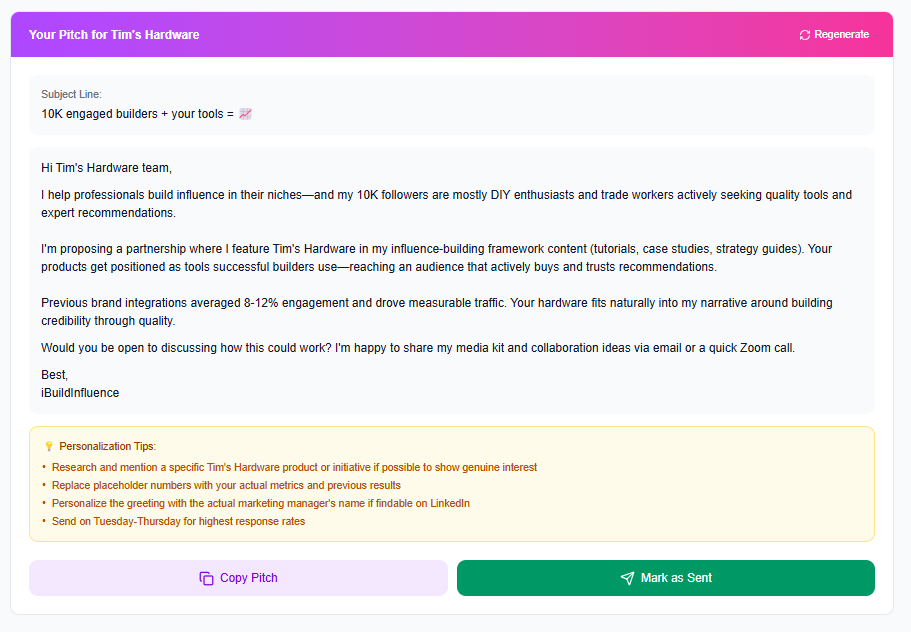
To keep the test fair, I used AI to generate multiple pitch variations, but I forced a strict structure. The winning formula wasn’t fancy; it was clear and skimmable:
Offer: One sentence stating the collaboration idea.
Proof: Two facts that reduce risk (reach/engagement or a relevant content example).
Next step: A low-friction action (ask if they handle creator partnerships, or propose a short call).
Example of a high-reply DM (paraphrased): “I’d love to do a 30–45s UGC style video showing how your product solves [specific use case]. My last similar post generated 8.1k views and a 6.4% engagement rate, and I’ve already scripted 3 hooks in your tone. Are you the right contact for creator deals this month?”
Example of a low-reply DM: “Hello! I’m reaching out with an AI pitch. I think your brand is amazing and my audience would love your product. I can create engaging content for you.” It’s not wrong—it’s just missing the parts a brand needs to decide quickly.
One of the biggest mistakes creators make when they use AI for outreach is equating personalization with superficial tweaks. Name-dropping (“I love what you do, [First Name]”) rarely changes outcomes. What does change outcomes is context: the brand’s current priorities, their content style, and how your idea fits into their existing ecosystem.
During the 50-DM test, I tried two personalization methods:
Method A (weak): Changed the brand name and one generic compliment line.
Method B (strong): Matched a recent post to a content angle, then proposed a specific deliverable format.
Method B produced materially more replies. Not every reply became a paid deal, of course—but the conversation got farther. A brand might not commit immediately, yet they’ll still respond when you’re clearly not guessing.
Practical steps to apply this today:
Step 1: Screenshot or save the last 1–3 posts the brand made in your niche (or their product pages that show positioning).
Step 2: Pick one message they’re already emphasizing (pain point, outcome, ingredient, lifestyle scene).
Step 3: Write your offer as a “proof-of-fit” sentence: “I’d build content that supports the same outcome you’re highlighting—only in my audience’s language.”
After the offer and proof, the next step determines whether you get ignored. Many creators ask for something big too early—like “Let’s work together” or “Are you interested?” That forces the brand to do extra thinking.
In my test, the DMs that got replies ended with a clear, easy-to-answer question. Examples include:
“Are you the right person for creator partnerships?”
“What’s your preferred format for UGC or creator videos?”
“Would you like a quick one-paragraph proposal with deliverables and timeline?”
These are not passive. They’re structured. Brands want clarity, and they want low effort. When you make it easy to reply, you’re not just being polite—you’re improving your conversion path.
If you’re building a content creator business plan and trying to transition from side hustle to full time, your outreach needs to operate like a system. Use a repeatable pitch workflow: generate → tailor → send → log response → follow up with a revised offer based on what they asked.
Also, follow-ups matter. In influencer marketing, a lot of “no reply” is actually “not seen.” Your follow-up should change something meaningful: timing, angle, or deliverables. A second message that adds one extra proof point often works better than “checking in.”
Let’s talk about the silent killers. Even if your writing is strong, brands ignore pitches that read like unlimited free work or unclear production expectations. In the test, the ignored messages had two recurring flaws:
1) No scope: I offered “content” without defining format, length, number of assets, usage rights, or timeline. That makes brands assume extra cost and risk—so they don’t respond.
2) No budget framing: I didn’t mention pricing approach or whether I was flexible. Some creators think they must be price-agnostic in DMs. But brands still need a starting point. Even “I’m typically in the $X–$Y range depending on usage rights” helps them route you correctly.
A practical fix: include 3 deliverables max in your first message. Example: “One video (30–45s), one still image, and one story/short repost.” Add one line on usage: “Paid usage for 30 days” or “Organic only” depending on your preference. This is how you protect your time and keep negotiations moving.
Bonus insight: If you’re trying to sell digital products creator-side (like templates, guides, or courses), your pitch should connect the product to an outcome and show how you’d drive action. “Would your audience like my content?” isn’t enough; “Here’s how I’ll move them from attention to a purchase” is.
AI can generate the words. But brands reply when your message proves fit, reduces risk, and makes the next step effortless.
If you want more than “good pitches,” you need a repeatable creator workflow that improves response rates over time. iBuildInfluence supports that with tools that cover the full pitch-to-payment loop. For example, Pitch Machine helps you generate brand outreach messages in seconds, but the real win is that you can quickly test multiple structures (offer/proof/next step) without starting from scratch every time.
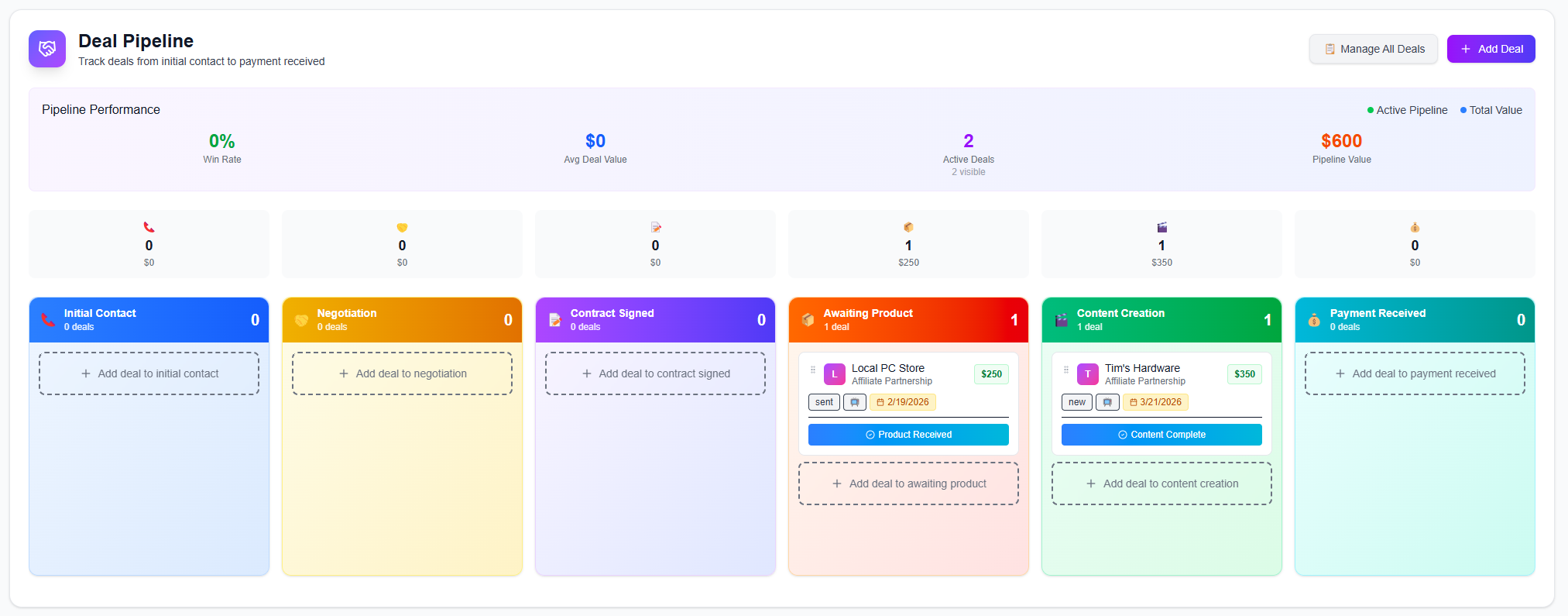
Once you get a response, Revenue Pipeline / Deal Pipeline lets you track the conversation from pitch to payment so nothing gets lost in DMs. You can also use the Media Kit tool to produce an investor-grade snapshot with live stats—so when a brand asks “what are your numbers?” you don’t scramble. If you’re optimizing how to get more views and improve performance, Social Statistics helps you reference real cross-platform metrics (saves, shares, engagement rate) when backing up your pitch.
Most creators see signal after 30–60 targeted messages, especially if you’re tailoring for context and tracking responses. If your niche is narrow and you match deliverables clearly, 50 DMs is a solid sample size to identify what gets replies vs. what gets ignored.
Your first DM should include a clear collaboration offer, 2 pieces of proof (relevant content results or audience stats), and an easy next step. Avoid open-ended requests like “let’s work together” and instead ask a specific question that takes the brand 10 seconds to answer.
It can, if the message is identical and lacks context. AI writing is fine, but personalization should be about matching a brand’s messaging and current priorities, not just swapping the brand name. Rewriting the structure or deliverables slightly per niche/brand is usually enough to improve outcomes.
Replies depend less on “AI quality” and more on relevance and context.
The best-performing DM structure was Offer → Proof → Next Step, kept short and skimmable.
Personalization that matters is message-matching (their recent content style and positioning), not name-dropping.
Use low-friction questions as your next step to make it easy for brands to respond.
Don’t get ignored for scope: include clear deliverables and basic budget/usage framing.
Found this helpful? Share it:
iBuildInfluence Team
Creator growth strategist at iBuildInfluence. Helping content creators land brand deals, grow their audience, and build sustainable creator businesses.
More from iBuildInfluenceJoin thousands of creators using iBuildInfluence to land brand deals, grow their audience, and build real income.
Start Free ΓÇö No Credit Card Required