
Platform Growth
How Small Channels Can Beat Big Creators (Smart Strategies)
July 25, 2026
Consistency isn’t just posting more—it’s a system. Learn how to build a creator workflow that compounds views, income, and audience trust.

If you’ve ever wondered why one creator seems to grow faster “for no reason,” the answer is usually not luck—it’s consistency. In 2026, audiences reward creators who show up reliably with content that gets progressively better. This post breaks down exactly how consistency wins, and what to do starting this week.
Most creators think consistency means “post every day.” But algorithms and audiences don’t just reward frequency—they reward predictability + learning + pattern recognition. When you publish consistently, you give your account enough data to learn what works: topics that earn saves, hooks that earn watch time, and formats that earn shares. Over time, your content becomes more repeatable and easier for viewers to choose.
Here’s the practical math: if you publish 3 posts per week for 6 months, that’s ~72 pieces of content. If you publish 1 post per week for the same time, it’s ~24. Even with the same skill level, the creator with 72 attempts has far more opportunities to find winning angles and double down. That’s why “consistency beats talent” is mostly shorthand for more reps.
To apply this, pick a schedule you can maintain even during busy weeks. Then track results by content theme rather than by random posts. For example, if you’re a fitness creator, run a 4-week mini-series: “Form checks,” “Myth vs fact,” “Beginner routines,” “Nutrition mistakes.” Consistency here means viewers can anticipate your next installment—and algorithms can connect your account with a clear topic cluster.
Motivation is unreliable. A workflow is not. Consistency fails when creators treat each post like a fresh start instead of a reusable process. The winning approach is to design a content creator business plan where every step has a template: ideation, scripting, recording/editing, posting, and review.
Use a simple weekly structure:
Day 1 (Ideation): generate 10–15 content angles. Day 2 (Production batch): record 2–4 videos or create 3–6 short posts. Day 3 (Editing + captions): finalize assets. Day 4 (Scheduling + community): post + reply to comments for 30–45 minutes. Day 5 (Review): analyze what earned saves/shares and decide the next week’s topics.
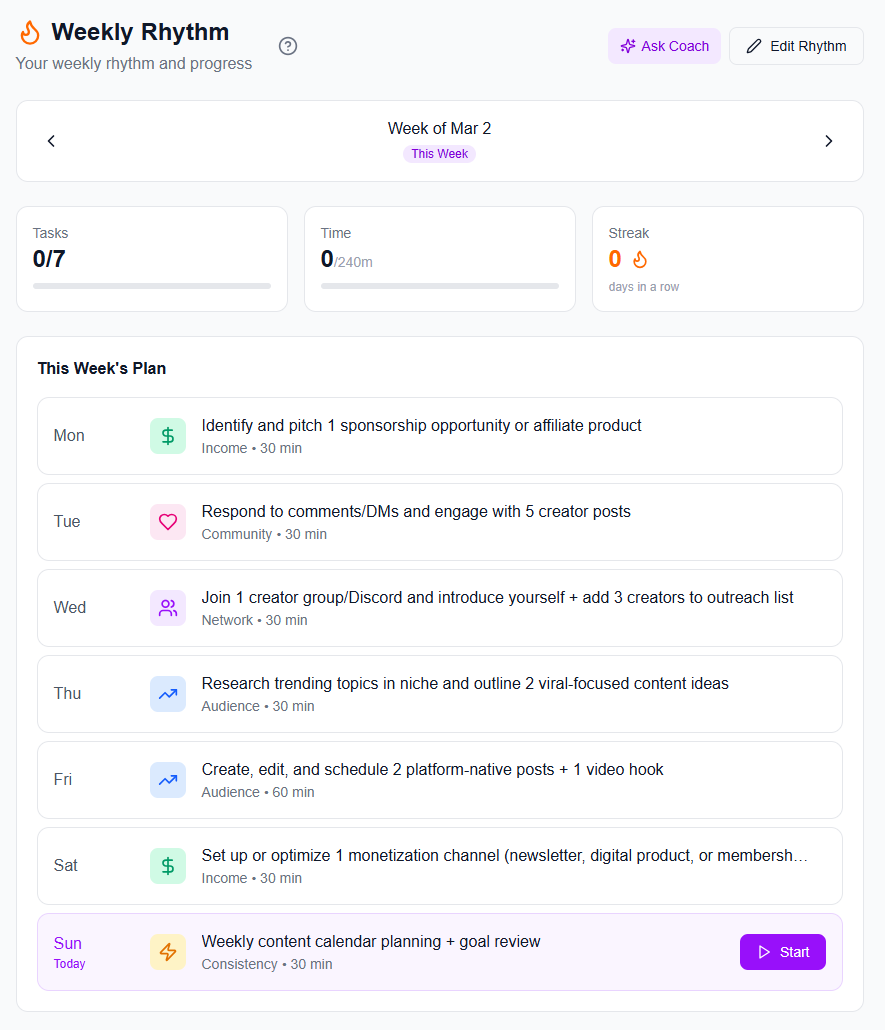
This reduces decision fatigue and makes your work repeatable. If you’re asking “how to transition from side hustle to full time,” the workflow matters as much as the posting cadence—because predictable output stabilizes your revenue pipeline.
If you want a ready-to-use starting point, pair this workflow with a content schedule. For more on that process, see Complete Guide to Building a Content Calendar for Consistent Views.
Consistent posting without improvement becomes noise. The key is to keep your baseline quality high while using your weekly review to iterate. Think of it like training: you don’t change every variable daily; you adjust the levers that move performance.
Start with your first 5 seconds. Most creators lose viewers before they ever deliver value. If you consistently test hooks, you’ll quickly learn which openings earn watch time and which openings cause instant drop-off. A strong hook is rarely “be louder.” It’s usually a clear promise, a specific curiosity gap, or a counterintuitive statement.
Then tighten clarity. Ask: can someone understand what the video is about within 1–2 seconds? Can they tell who it’s for? If the answer is no, consistency becomes expensive because viewers won’t stay long enough for the algorithm to “learn” you.
Here’s a practical iteration cycle you can run every week:
Step 1: take your top-performing post from the last 7 days.
Step 2: break down why it worked: topic, hook, structure, visual clarity, call-to-action.
Step 3: create 3 follow-ups using the same structure but new angles (example: “same format” with “new story” + “new example”).
Step 4: produce 1 “control post” that’s different, so you don’t get trapped in one style.
If you want a deeper hook framework, read The First 5 Seconds Is Everything — A Creator's Guide to Viral Hooks.
Consistency isn’t only about growth; it’s about trust. When viewers see you show up repeatedly with value, they start to expect results. That expectation is what converts casual viewers into subscribers, fans, and buyers. In other words: consistency reduces “buyer hesitation.”
To make this real, create content that does one of these every week:
Teach one repeatable skill (e.g., “how to edit retention into Shorts”). Document your process (e.g., “Day 12 of fixing my hook strategy”). Deliver a curated list (e.g., “5 creators I’m learning from and what to steal”). Or Prove outcomes (e.g., “here’s my analytics after 30 days”).
Then connect your consistency to revenue. For example, a creator posting 3 times per week can build toward digital product sales by timing offers after proof. If you’ve published 12–15 posts in a niche, you’ll notice recurring questions in comments and DMs. Those questions are your offer roadmap.
A realistic monetization path looks like this:
Weeks 1–4: establish topic clarity and teach fundamentals.
Weeks 5–8: build a mini-audience asset (lead magnet or email list) and start collecting “what they want next.”
Weeks 9–12: launch a simple digital product (templates, scripts, checklists) based on those questions.
This “sell digital products creator” approach works because you’re not pitching strangers—you’re helping the same people who have already watched you consistently.
Want to connect consistency to income even faster? Review how creator offers can be structured for stable earnings in Packaging & Retainers: Monthly Income from Creator Deals.
One of the biggest reasons creators break consistency is they keep posting without knowing what to stop. If everything feels equally important, you’ll either quit or flood your schedule with low-return content. Analytics gives you permission to be selective while still staying consistent.
Cross-platform analytics matters because each platform rewards slightly different signals. On YouTube, watch time and retention are king. For short-form, saves and shares often predict long-term reach. Instagram can behave differently depending on formats and distribution. Instead of chasing “viral,” track outcomes that align with your goals: reach, engagement rate, and repeatable performance.
Try this weekly analytics checklist (30 minutes total):
1) Which topic performed best (not just the format)?
2) Which hook style led to the highest average view duration?
3) Which posts earned the most saves/shares or comments with substance?
4) Which posts underperformed—and did they fail on hook or on value?
5) What single change will you test next week?
This keeps consistency sustainable. You’ll still post on schedule, but your effort improves because you’re directing it toward what’s already working. Over time, this is how you learn how to get more views without needing constant inspiration.
Consistency doesn’t mean never changing. It means making improvement automatic—so your best work happens on time, every time.
Consistency is easier when your planning, production, and review are connected. iBuildInfluence supports that with Content Planner & Content Queue, so you can plan weeks of content and auto-schedule posts instead of scrambling at the last minute. You can also use the Creator Coach to get personalized guidance that keeps your weekly output aligned with your goals and format preferences.
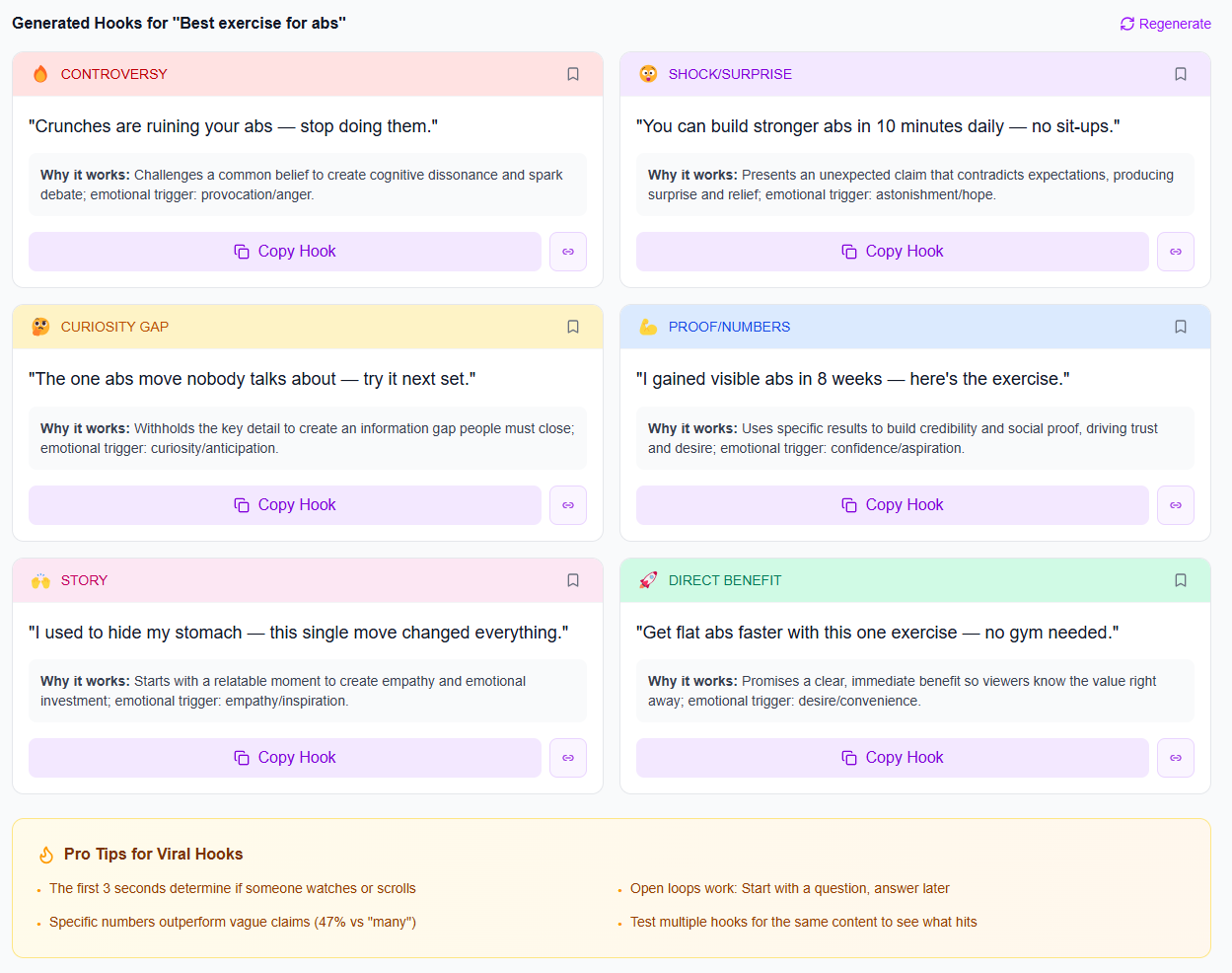
For the “quality control” portion, iBuildInfluence includes tools that help you execute faster without losing your voice. The Hook Lab generates and scores viral hook ideas (so you can test what earns attention), while Social Statistics helps you review performance across platforms using signals like engagement rate and reach—turning your analytics into next-week decisions. If you’re building your content creation workflow around speed and clarity (including content creation tools 2026), these tools help you stay consistent without burning out. Plans start at $9/month (Starter) and $19/month (Pro) with a 14-day free trial.
Start with a cadence you can maintain through stress and busy weeks—often 2–4 posts per week. Consistency matters more than perfection, so aim for output you can sustain for 8–12 weeks and then adjust based on performance.
Yes, but not in the simplistic “post daily” way. The YouTube algorithm 2026 responds to signals like retention, watch time, and viewer satisfaction, and consistent publishing increases the chances you’ll find those winning patterns faster.
A simple weekly workflow is: generate ideas, batch record/create, edit and schedule, publish, then review analytics to plan the next week. Using tools to manage the content schedule reduces decision fatigue and protects your consistency.
Consistency wins because it creates compounding data: more reps lead to faster learning and clearer audience alignment.
A repeatable content creator workflow beats motivation—templates and batching keep you publishing even during busy weeks.
Consistency must include quality control: test hooks, improve clarity, and iterate weekly based on what performed.
Consistent value builds trust, which makes monetization (digital products, offers, brand deals) feel natural.
Use analytics to stay consistent sustainably—track signals that matter, stop low-return work, and double down on winners.
Found this helpful? Share it:
iBuildInfluence Team
Creator growth strategist at iBuildInfluence. Helping content creators land brand deals, grow their audience, and build sustainable creator businesses.
More from iBuildInfluenceJoin thousands of creators using iBuildInfluence to land brand deals, grow their audience, and build real income.
Start Free ΓÇö No Credit Card Required