Creator Tips
iBuildInfluence: Run Your Entire Creator Week in One Place
September 3, 2026
Stop chasing virality. Learn social SEO to earn repeatable discovery—rankable content built from searchable answers, intent, metadata, and consistent engagement signals.
Going viral is flashy—but it’s also unreliable. If you want a repeatable growth engine, you need social SEO: the skills that help your content get discovered through search, recommendations, and consistent ranking signals. The best part? You can build it without gambling on luck.
Social SEO works when your content becomes a searchable answer—not just a scroll-stopper. On platforms like YouTube, TikTok, Instagram, and Pinterest, discovery isn’t only driven by shares; it’s driven by systems that match user intent to your content. Those systems look at metadata (titles, descriptions, captions), engagement behavior (watch time, replays, completion), and topical consistency (whether your channel keeps serving the same themes).
Here’s a grounding stat mindset: across major platforms, the “algorithm” is heavily influenced by user satisfaction signals—how long viewers stay, how often they return, and whether your content is deemed relevant to a topic. For creators, that means the goal isn’t “get as many views as possible,” but “earn placement for specific queries.” Instead of asking, “How do I go viral?” switch to: What would someone type or search when they need what I teach?
Action step: pick one primary niche topic and one secondary topic for the next 30 days. Then build a small list of “intent phrases” you can answer. Example: if you’re a productivity creator, your intent phrases might be “how to plan a week,” “how to stop procrastinating,” and “best daily routine for busy people.” Your next posts should map to those phrases—not random trends.
Keyword mapping is the difference between “posting” and “ranking.” Traditional SEO uses page titles and headings; social SEO uses titles, on-screen text, spoken keywords, descriptions, and content series format. The key is to treat each piece of content like a landing page for one search intent—even if the platform doesn’t show you classic search results.
Try this simple framework: 1 video = 1 intent = 1 promise. For example, a YouTube Short or a TikTok about budgeting should focus on one intent: “budgeting for beginners.” Your title and first seconds should confirm that intent. Your spoken script should include the phrase naturally (not keyword stuffing), and your caption/description should reinforce it. If you do this consistently, the platform gets clearer signals about what you’re “about,” which improves matching over time.
Practical example: Suppose you want to get more views for “content creator workflow.” Create a 60-second video titled “My Content Creator Workflow (From Idea to Posting).” In the first 2 seconds, say: “If you’re wondering how to structure your content creator workflow, here’s mine.” Then include a three-step structure on screen: Plan → Produce → Publish. In your description, add 2–3 variations of the intent phrase: “content creator workflow,” “how to plan content,” and “tools to manage content schedule.” Over time, you’re training the system to associate you with that topic.
Want a stronger foundation for hooks? Use hook-first thinking so your titles don’t just sound good—they earn watch time. If you want a targeted approach, read The First 5 Seconds Is Everything — A Creator's Guide to Viral Hooks and adapt it for intent-based viewing (not just hype).
Social SEO is won or lost in the first moments—because relevance and retention decide distribution. Your packaging includes everything a viewer sees before and during the “decision window.” That includes your title (or on-screen headline), your first line, your thumbnail, and your caption structure (including hashtags where appropriate).
Think of your title as a query response. If someone searches “YouTube algorithm 2026 how to get more views,” your content shouldn’t feel like it’s about “random growth hacks.” It should feel like a direct answer. On YouTube, the title + thumbnail must align with the first 5–15 seconds. On short-form platforms, the hook must match the topic promise so viewers don’t bounce.
Here’s a packaging checklist you can reuse: 1) Title promise: contains the intent phrase in plain language (e.g., “How to Get More Views Without Going Viral”).
2) First-second confirmation: say or show the outcome immediately (e.g., “In the next 60 seconds, I’ll show you the exact steps to rank.”).
3) Visual headings: use on-screen labels like “Step 1,” “Step 2,” “Mistakes,” or “Templates.”
4) Description reinforcement: include 1–2 variations of the topic, plus an optional “who it’s for.”
5) Series labeling: create series titles (e.g., “Social SEO Sprint #1”) to train repeat viewers.
One more insight: thumbnails and titles don’t need to be clickbait—they need to reduce uncertainty. When viewers instantly understand what they’ll get, you increase satisfaction signals (higher completion, more replays), which improves ranking. That’s how “not viral” content starts earning consistent discovery.
Search ranking and recommendation systems both benefit from measurable satisfaction. Watch time, replays, comments that show comprehension, saves, and shares are all evidence that your content was useful. But you can’t “optimize satisfaction” by being vague—you optimize it with structure.
Structure templates that work well for social SEO: • The “Problem → Framework → Example → Next step” video. People save frameworks and examples. Example flow: “If your content isn’t getting found, here’s the framework. Step A, Step B, then an example from my channel. Next, copy this template.”
• The “Myth → Reality → Proof” format. Reality-based claims earn trust; proof earns retention. Example: “Myth: you need to go viral to grow. Reality: you need to rank. Proof: these posts started bringing search traffic after I changed my titles.”
• The “Checklist” format. Checklists are naturally saveable and repeatable. Example: “7 packaging tweaks to improve social SEO.”
Practical step: before you record, write a 4-line outline: 1) What the viewer is trying to solve.
2) Your one-sentence method.
3) Two examples tailored to a specific audience segment.
4) The next action (a template, a link, or a step they can do today).
Then measure results with cross-platform analytics. If you notice one format consistently earns saves and high completion, turn that into a repeatable series. You’re building a channel catalog that search systems recognize as “the place for X.” If you want help designing consistent output, use Complete Guide to Building a Content Calendar for Consistent Views and schedule around your top intents—not your mood.
Viral content is a moment. Social SEO is a library. A ranking library is a group of videos/posts that cover a topic from multiple angles: fundamentals, mistakes, advanced tactics, and examples. Over time, that library starts to rank for multiple related queries because you’ve demonstrated depth and relevance.
For example, if your niche is creator marketing, you wouldn’t post only one “brand deals tips” video.
You’d create a cluster:
• What to include in a media kit
• How to write outreach that gets replies
• How to set rates
• How to negotiate deliverables
• Case study breakdowns
Each video targets a specific intent phrase, but they all reinforce the same topical identity. This is exactly how you transition from “random engagement” to “predictable discovery.” It also helps you how to transition from side hustle to full time because your content becomes an acquisition channel for deals, digital products, and collaborations—not a one-time performance.
Action step: run a 30-day “ranking sprint.” Choose 3 core intents and create 2 pieces per intent per week (6–12 total). Do not chase new topics every day. You’re training systems to understand your theme. At the end of the month, review which intents drove the strongest combination of completion, engagement rate, and search-like behavior (traffic that isn’t only from followers). Then double down on the winners.
Social SEO isn’t about becoming famous overnight—it’s about becoming the answer that shows up again and again.
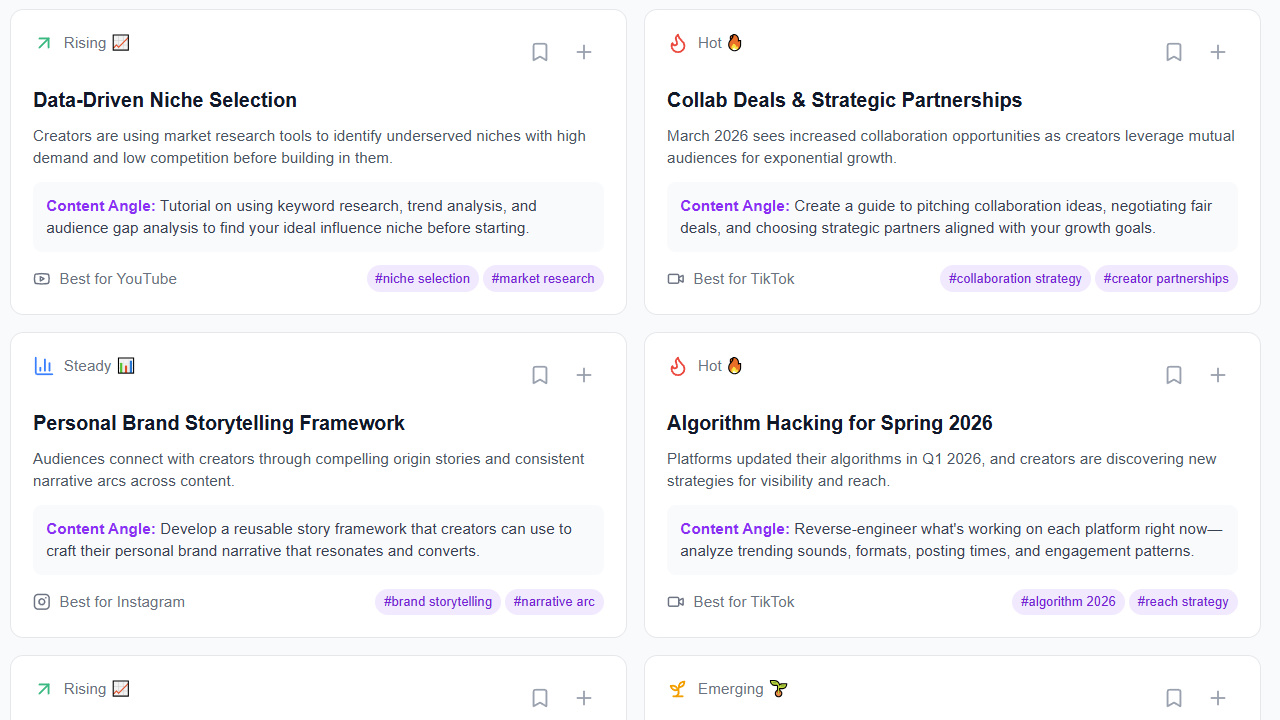
Building social SEO is hard to do consistently when you’re juggling ideas, scripts, publishing, and analytics. iBuildInfluence helps you run a creator-specific content workflow so you can focus on ranking instead of scrambling. Start with Trend Scout to find topics before they peak, then use Hook Lab to generate and score hooks for your intent (so viewers stay long enough for ranking signals). For packaging, the Content Generator can turn one idea into a full content package—script, caption, and structured deliverables you can reuse across a series.
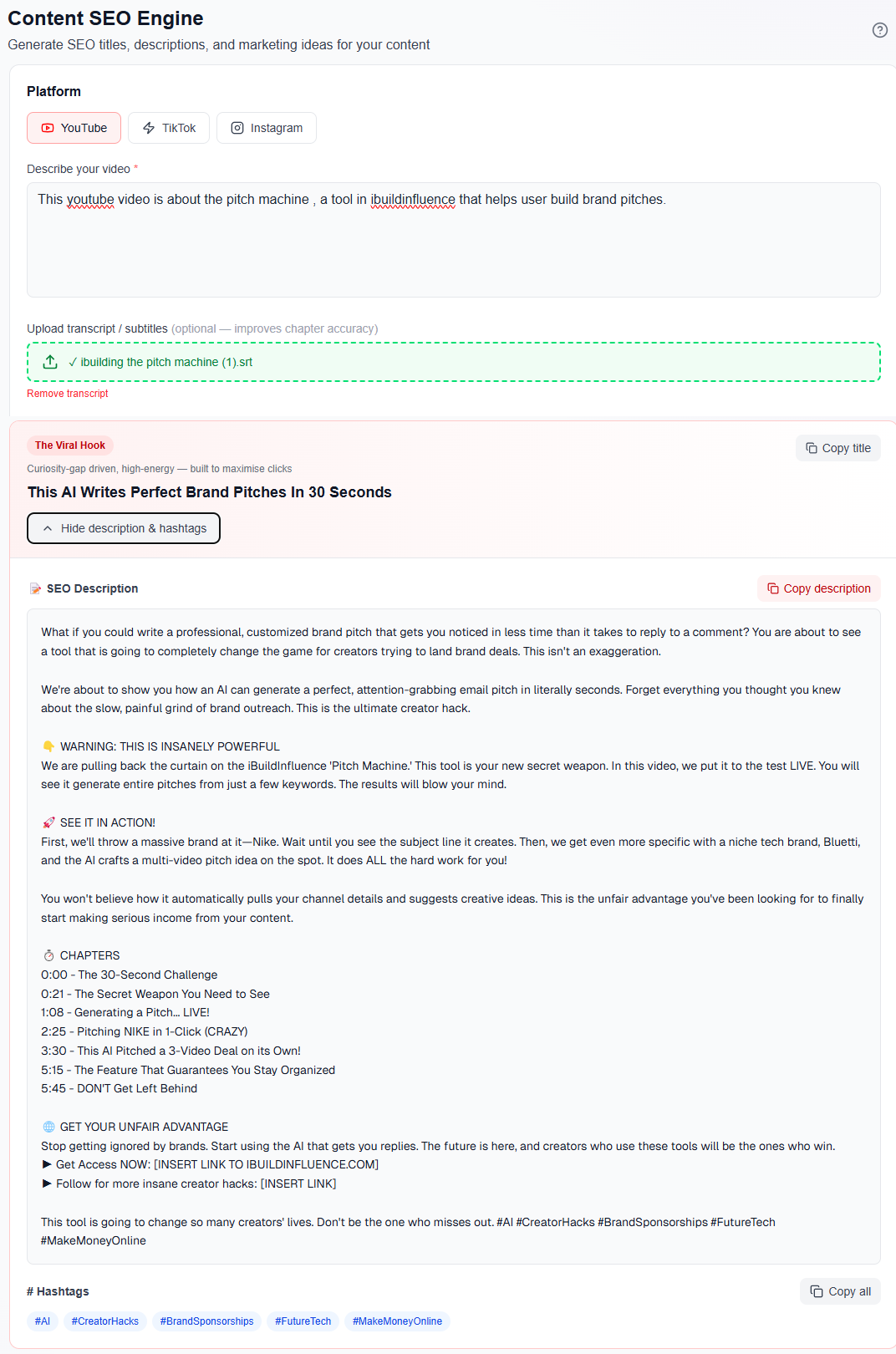
To make ranking measurable, use Social Statistics for cross-platform analytics (reach, engagement rate, and performance signals) and then schedule around what works with Content Planner & Content Queue. If you’re also monetizing alongside growth, iBuildInfluence supports the full creator loop—so your social SEO traffic can convert into income (for example through your Media Kit and deal tracking in Deal Pipeline).
Social SEO is the practice of optimizing your content for discovery inside social platforms and creator recommendation systems. Regular SEO focuses on ranking in search engines like Google, using page structure and backlinks. Social SEO focuses more on intent matching (titles/captions), retention signals, and topical consistency across posts.
Target specific intent phrases and build a ranking library with a repeatable structure (problem → framework → example → next step). Improve packaging so the viewer immediately understands the topic, then track performance signals like completion rate, replays, and saves. Consistency over time matters more than one explosive post.
Look beyond raw views and focus on satisfaction signals: watch time/completion, replays, shares, and saves. Comments that show understanding and return-viewer behavior are also strong indicators. Use analytics to identify which formats and topics drive those signals, then double down.
Social SEO is ranking behavior: optimize for intent, retention, and topical consistency—not just hype.
Use keyword mapping: assign one intent per post and reinforce it in title, first seconds, captions, and descriptions.
Improve packaging for clarity: reduce uncertainty with clear promises and on-screen structure.
Build a ranking library: cluster content around core intents so discovery compounds over time.
Measure and iterate: track satisfaction metrics (completion, replays, saves) and schedule based on what ranks.
Found this helpful? Share it:
iBuildInfluence Team
Creator growth strategist at iBuildInfluence. Helping content creators land brand deals, grow their audience, and build sustainable creator businesses.
More from iBuildInfluenceJoin thousands of creators using iBuildInfluence to land brand deals, grow their audience, and build real income.
Start Free ΓÇö No Credit Card Required